BirdLoop — A Personal Space for Birds
BirdLoop — A Personal Space for Birds
Type
Personal Project
Duration
8 Weeks
May-July 2026
My role
UX Research
UX/UI Design
Prototyping
Type
Personal Project
Duration
8 Weeks
May-July 2026
My role
UX Research
UX/UI Design
Prototyping
Our relationship with birds doesn't begin and end with observation. A bird can enter our lives through a photo, a video, a drawing, a funny voice, or a moment we happen to notice. We might save it, learn about it, create something inspired by it, or simply remember how it made us feel.
Yet these small moments are often scattered and easily forgotten.
Most birding tools focus on identifying and recording observations. Birdloop explores what happens beyond observation—the things we discover, create, collect, and remember around the birds we love. It is a lightweight bird guide and personal space for turning these moments into something we can keep. Because sometimes, we don't just want to remember the birds we've seen. We want to remember why we love them.
Our relationship with birds doesn't begin and end with observation. A bird can enter our lives through a photo, a video, a drawing, a funny voice, or a moment we happen to notice. We might save it, learn about it, create something inspired by it, or simply remember how it made us feel.
Yet these small moments are often scattered and easily forgotten.
Most birding tools focus on identifying and recording observations. BirdLoop explores what happens beyond observation—the things we discover, create, collect, and remember around the birds we love.
It is a lightweight bird guide and personal space for turning these moments into something we can keep. Because sometimes, we don't just want to remember the birds we've seen. We want to remember why we love them.
Birds inspire more than observation!
A bird can make us curious, make us smile, or inspire us to create something of our own. People turn their fascination with birds into art, humor, crafts, and other forms of expression.

Birds inspire more than observation!
A bird can make us curious, make us smile, or inspire us to create something of our own. People turn their fascination with birds into art, humor, crafts, and other forms of expression.
People build their own ways of connecting with birds
I looked at how people engage with birds beyond field observation—from saving images and learning about species to keeping journals, making art, and creating personal interpretations.

Sources: Japanese users and creators on note
How do people engage with birds beyond observation ?
Sample: N = 15 public bird-related posts/articles
Sources: Japanese Note + Reddit
Unit of analysis: individual post / article
Method: manual coding of explicitly expressed behaviors
Purpose: identify recurring patterns, not estimate population prevalence.
What I found
Interest doesn't require expertise.
Bird interest is not limited to knowledgeable birders.
Birds become part of personal memories.
People connect birds with personal experiences and memories.
Bird interest takes many forms.
People express and preserve their interest through journals, art, crafts, lists, and other personal forms.
Insight
Bird interest can become something people collect, record, and revisit—not just something they observe.
Contrast

Existing experience
Primarily organize birds through identification, species information, and observation records.

People build their own ways of connecting with birds
I looked at how people engage with birds beyond field observation—from saving images and learning about species to keeping journals, making art, and creating personal interpretations.
Sources: Japanese users and creators on note
How do people engage with birds beyond observation ?
Sample: N = 15 public bird-related posts/articles
Sources: Japanese Note + Reddit
Unit of analysis: individual post / article
Method: manual coding of explicitly expressed behaviors
Purpose: identify recurring patterns, not estimate population prevalence.
What I found
Interest doesn't require expertise.
Bird interest is not limited to knowledgeable birders.
Birds become part of personal memories.
People connect birds with personal experiences and memories.
Bird interest takes many forms.
People express and preserve their interest through journals, art, crafts, lists, and other personal forms.
Existing experience
Primarily organize birds through identification, species information, and observation records.
Contrast
Insight
Bird interest can become something people collect, record, and revisit—not just something they observe.
How might we help people keep and revisit the different ways they connect with birds?
Design principles
Personal, not just factual
Keep personal experiences alongside bird information.
Flexible, not activity-bound
Support different ways of connecting with birds.
Easy to revisit
Make past birds, moments, and memories easy to return to.
Organized around how people remember
Structure experiences around meaningful ways of recalling them.
How might we help people keep and revisit the different ways they connect with birds?
Design principles
Personal, not just factual
Keep personal experiences alongside bird information.
Flexible, not activity-bound
Support different ways of connecting with birds.
Easy to revisit
Make past birds, moments, and memories easy to return to.
Organized around how people remember
Structure experiences around meaningful ways of recalling them.
Decision 01 - What could a “bird record” look like ?
(Define the nature of the record)

Decision 02 - What could become a “bird record” ?
(Define what can be kept)

A moment with a bird doesn't need a category. A photo, a doodle, a meme, a joke, or something that caught your attention. Forcing it into a category adds an unnecessary decision. Just save it.
Decision 03 - How should records be revisited ?
(Define how the archive is organized)

From archive to ongoing connection
But a personal archive isn't only about looking back.
It's also a way to keep the connection going.
Research-informed ideation
Building on the research, I explored lightweight ways for people to keep discovering, learning about, and getting to know the birds they care about—even when they have nothing new to record.
I filtered these ideas through the design principles and the core purpose of the product.

Alternative exploration
These explorations helped define how BirdLoop should feel as a product. Rather than adding more functionality, I focused on making each interaction purposeful and coherent with the product’s core idea of a personal space for birds. The decisions were shaped by the role each experience plays, the needs identified through research, and feedback from bird enthusiasts, with an emphasis on keeping the experience personal, lightweight, and easy to return to.


Structuring the experience
After exploring the individual experiences, I stepped back to define how they should come together as a coherent product.
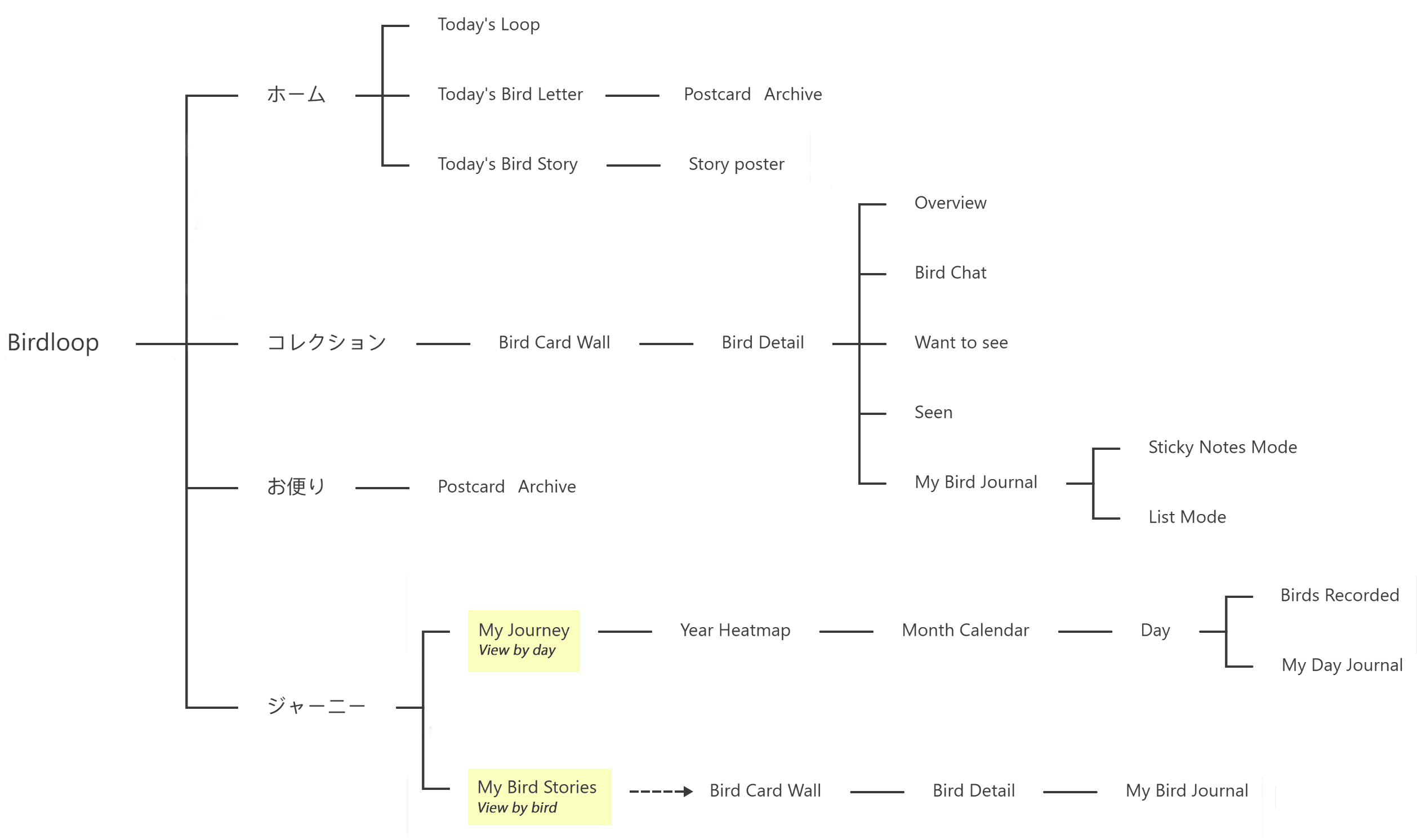
Experience Flows
I explored how BirdLoop could fit into different moments of bird-related interest—not only observation, but also discovery, creation, and memory.
01 — Discover a bird story on the way
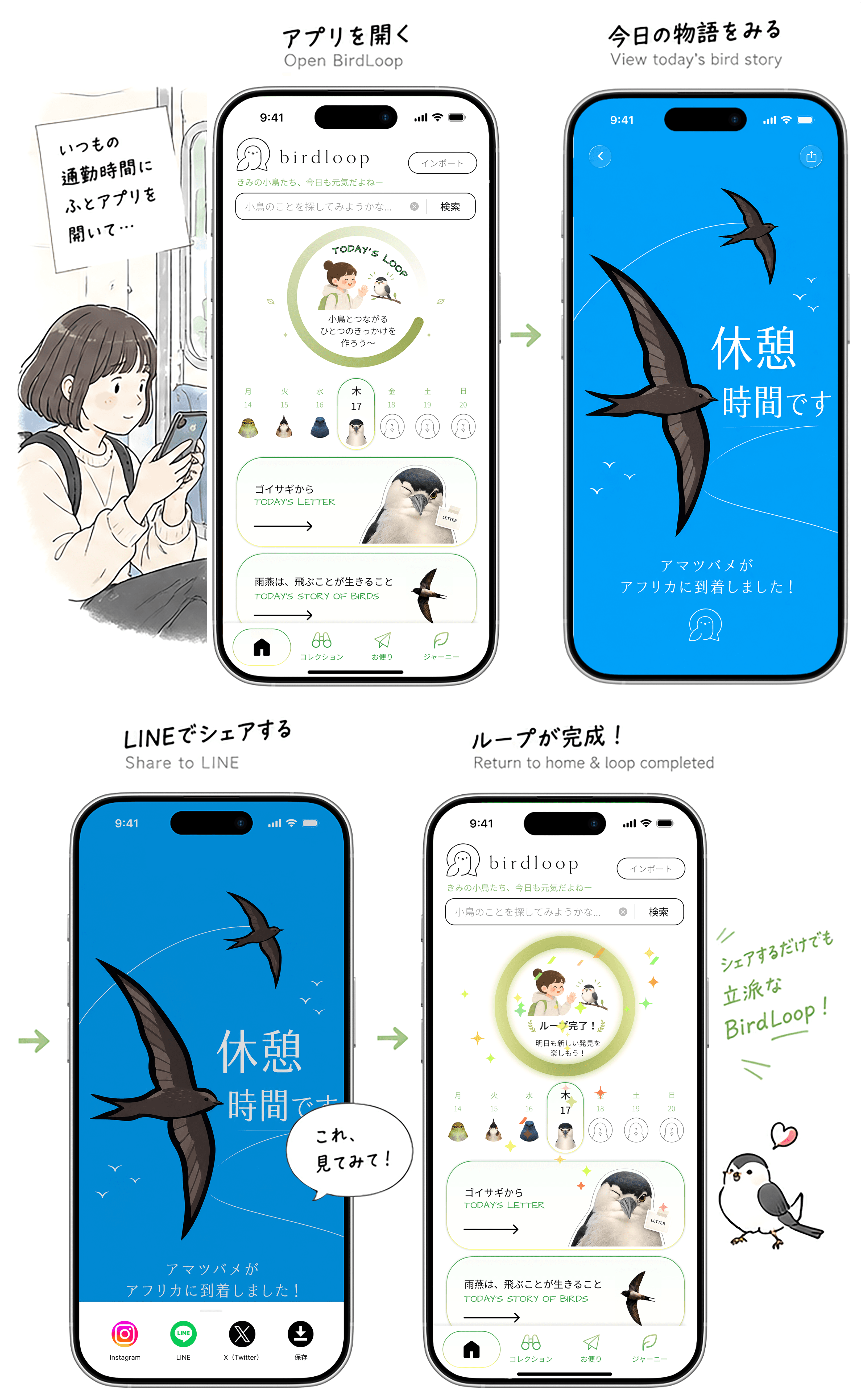
02 — From online fascination to a real encounter

03 — Birds inspire creation

Evaluation & Reflection
The challenge:
Staying connected beyond observation
Having kept pet birds for more than ten years, I have always been particularly interested in birds. But birdwatching itself can be difficult to sustain. Time, location, season, and simple chance can all determine whether we actually encounter the bird we want to see. At the same time, most existing bird journals are centered around observation records, while field guides and notebooks often provide little more than space to write after each species. Yet my own experience with bird enthusiasts showed that our interest extends far beyond observation. We share bird memes, animations, artworks, exhibitions, photos, and other small discoveries—many of which end up scattered across screenshots, downloads, bookmarks, and chat histories.
What I explored:
A more personal bird archive
These observations led me to explore BirdLoop as a personal space for birds, rather than another observation or social platform. The challenge was to find a place for BirdLoop within an already diverse ecosystem, from eBird and Merlin to bird journals, field guides, and social platforms such as Birda. Since I had personally used many of these products and discussed them with other bird enthusiasts, I explored what was missing from my own experience: a more visual and personal archive for the things I discover, create, remember, and want to revisit around birds. This also shaped the product’s visual direction, where the bird itself becomes the primary visual anchor and personal moments can be recorded without having to become formal observations.
Moving forward
BirdLoop is still a design exploration, and several questions would require further research and testing. I would like to understand how people naturally revisit and organize their bird-related memories as their archive grows, and how different forms of content can remain lightweight and flexible without being forced into predefined formats. I would also explore the boundary between a private personal archive and social interaction—whether people would eventually want to share parts of their archive or connect with other bird enthusiasts, and how that might affect the intimacy of the experience.
Product & Tech
Designing for users also means designing for sustainability.
Features such as Bird Chat and other AI-powered interactions may rely on external APIs, introducing ongoing usage and infrastructure costs. Beyond validating user needs, a real product would also need to balance experience value, technical feasibility, and business sustainability so that the experience can be maintained and improved over time.
Visual Language & Refinement
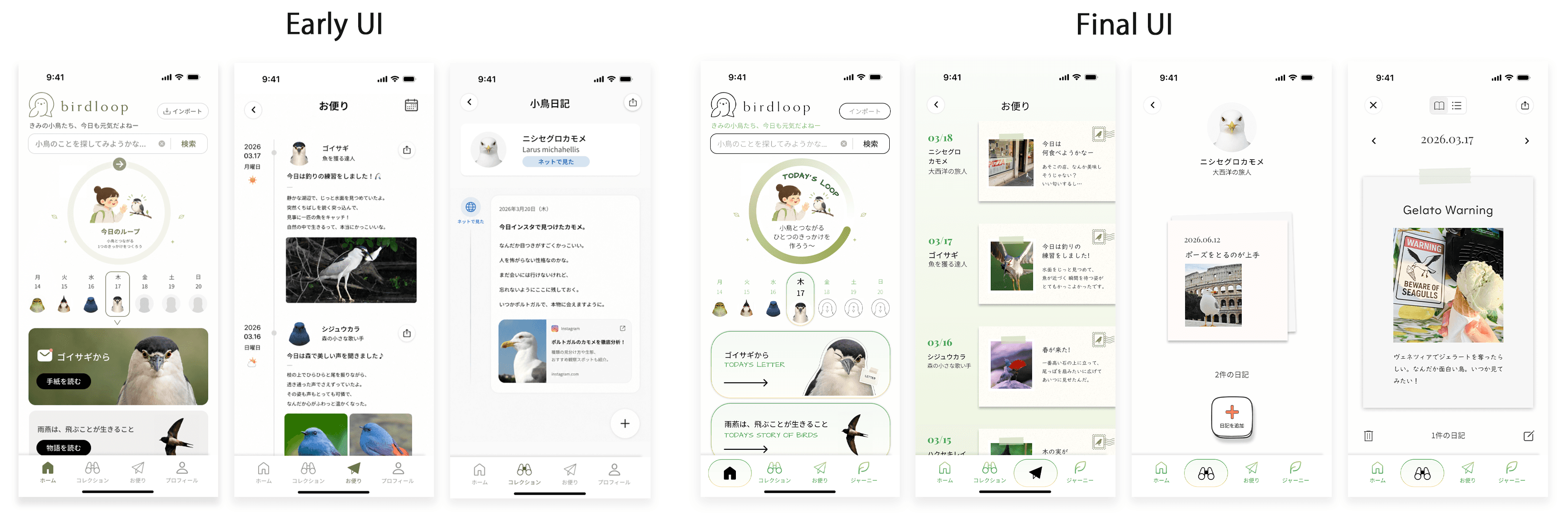
The early visual direction felt visually dense and somewhat conventional. I gradually refined BirdLoop to feel lighter, warmer, and more distinctive by reducing visual density, creating more breathing room, moving beyond conventional content cards, and giving birds a more active role in the visual language. I also introduced softer, more organic forms, a restrained nature-inspired palette, and typography with more personality. Together, these changes shifted BirdLoop from a content-driven interface toward a more personal visual space where birds themselves become the recurring visual presence.
From content-heavy → Lightweight& Spacious
The early design felt dense and somewhat conventional. I introduced more white space and clearer visual grouping to make the experience feel lighter.
From conventional content cards → Playful & Organic
I moved away from a standard content-card structure and introduced softer shapes, organic compositions, and small expressive details.
From photography-led → Bird-character-led
Birds became more than content imagery. Portraits, cut-outs, and illustrations became part of the interface itself. Birds became part of the visual language, not just content.
From realistic / editorial → Warm & Personal
I introduced hand-drawn characters, illustrated birds, and softer details to make the experience feel more personal and approachable.
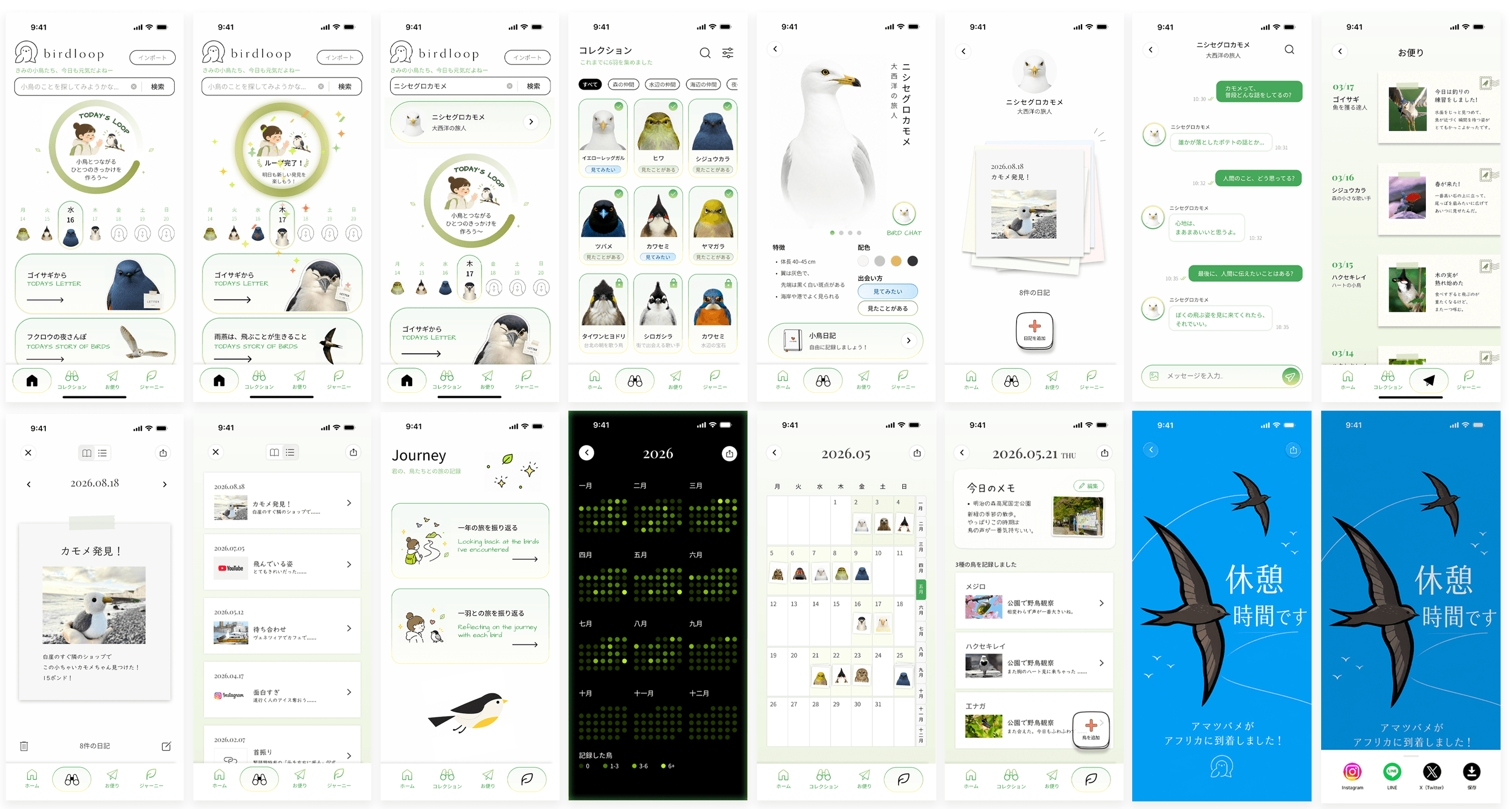
A restrained, nature-inspired color language
Warm White · Soft Green · Black · Subtle Yellow
The palette was simplified around warm white, soft green, black, and subtle yellow accents to create a calmer and more cohesive experience.
Typography as part of the personality / Clean + Playful
Clean typography keeps the interface readable, while selected expressive type treatments add a lighter and more playful character.

BirdLoop - A Personal Space for Birds
Our relationship with birds doesn't begin and end with observation.
A bird can enter our lives through a photo, a video, a drawing, a funny voice, or a moment we happen to notice. We might save it, learn about it, create something inspired by it, or simply remember how it made us feel.
Yet these small moments are often scattered and easily forgotten. Most birding tools focus on identifying and recording observations.
BirdLoop explores what happens beyond observation—the things we discover, create, collect, and remember around the birds we love. It is a lightweight bird guide and personal space for turning these moments into something we can keep.
Because sometimes, we don't just want to remember the birds we've seen. We want to remember why we love them.
Type
Personal
Project
Duration
8 Weeks
May-July 2026
My role
UX Research
UX/UI Design
Prototyping
Birds inspire more than observation!
A bird can make us curious, make us smile, or inspire us to create something of our own. People turn their fascination with birds into art, humor, crafts, and other forms of expression.

People build their own ways of connecting with birds
I looked at how people engage with birds beyond field observation—from saving images and learning about species to keeping journals, making art, and creating personal interpretations.
Sources: Japanese users and creators on note

How do people engage with birds beyond observation ?
Sample: N = 15 public bird-related posts / articles
Sources: Japanese Note + Reddit
Unit of analysis: individual post / article
Method: manual coding of explicitly expressed behaviors
Purpose: identify recurring patterns, not estimate population prevalence.
What I found
Interest doesn't require expertise.
Interest doesn't require expertise.
Bird interest is not limited to knowledgeable birders.
Birds become part of personal memories.
People connect birds with personal experiences and memories.
Bird interest takes many forms.
Personal connection takes different forms.
People express and preserve their interest through journals, art, crafts, lists, and other personal forms.
Existing experience
Primarily organize birds through identification, species information, and observation records.
Contrast

Insight
Bird interest can become something people collect, record, and revisit—not just something they observe.
How might we help people keep and revisit the different ways they connect with birds?
Design principles
Personal, not just factual
Keep personal experiences alongside bird information.
Flexible, not activity-bound
Support different ways of connecting with birds.
Easy to revisit
Make past birds, moments, and memories easy to return to.
Organized around how people remember
Structure experiences around meaningful ways of recalling them.
Decision 01 - What could a “bird record” look like ?
(Define the nature of the record)
Decision 02 - What could become a “bird record” ?
(Define what can be kept)
A moment with a bird doesn't need a category.
A photo, a doodle, a meme, a joke, or something that caught your attention. Forcing it into a category adds an unnecessary decision. Just save it.
Decision 03 - How should records be revisited ?
(Define how the archive is organized)

From archive to ongoing connection
But a personal archive isn't only about looking back. It's also a way to keep the connection going.
Research-informed ideation
Building on the research, I explored lightweight ways for people to keep discovering, learning about, and getting to know the birds they care about—even when they have nothing new to record. I filtered these ideas through the design principles and the core purpose of the product.
Alternative exploration
These explorations helped define how BirdLoop should feel as a product. Rather than adding more functionality, I focused on making each interaction purposeful and coherent with the product’s core idea of a personal space for birds. The decisions were shaped by the role each experience plays, the needs identified through research, and feedback from bird enthusiasts, with an emphasis on keeping the experience personal, lightweight, and easy to return to.
01 — Collection

02 — Bird identity

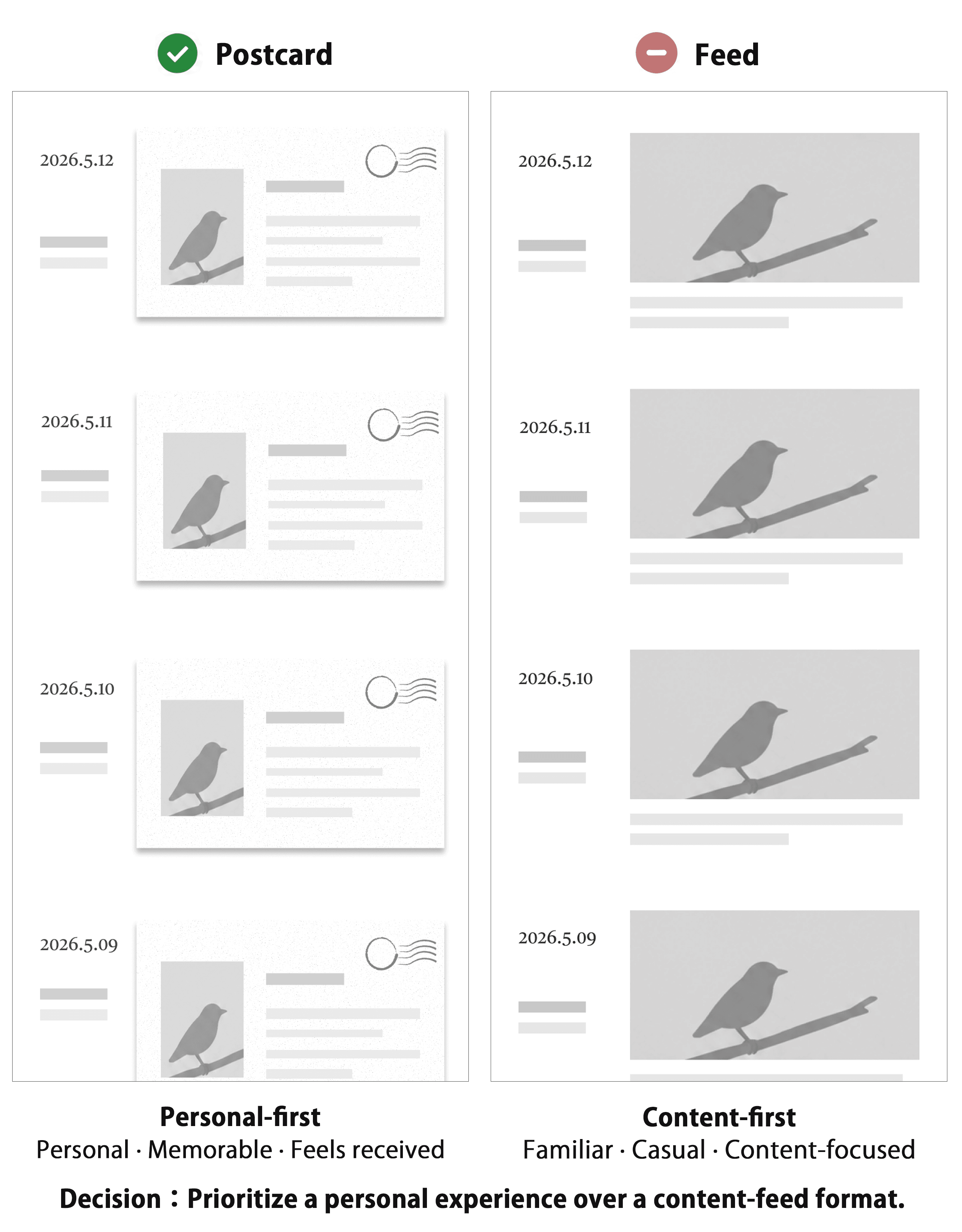
Since BirdLoop is a personal space rather than an observation database, I wanted the bird itself to remain the primary visual anchor. A standardized portrait gives each bird a recognizable identity and makes the collection feel more like getting to know individual birds than browsing observation data.
03 — Bird Story

Bird Story is a supporting experience, not the main archive. I wanted it to give users a small moment of discovery without competing with the journal itself. I therefore reduced the story from a longer reading experience into a lightweight daily poster.
04 — Bird Letter
Structuring the experience
After exploring the individual experiences, I stepped back to define how they should come together as a coherent product.
Daily Loop
After exploring the core experience, I built a prototype and discussed it with bird enthusiasts to understand their reactions and preferences. One thing stood out: they enjoyed small, occasional moments of positive feedback when interacting with the app.

Experience Flows
I explored how BirdLoop could fit into different moments of bird-related interest—not only observation, but also discovery, creation, and memory.
01 — Discover a bird story on the way

02 — From online fascination to a real encounter
03 — Birds inspire creation
Visual Language & Refinement
Content-heavy → Lightweight & Spacious
The early design felt dense and somewhat conventional.
I introduced more white space and clearer visual grouping to make the experience feel lighter.
Conventional content cards → Playful & Organic
I moved away from a standard content-card structure and introduced softer shapes, organic compositions, and small expressive details.
Photography-led → Bird-character-led
Birds became more than content imagery. Portraits, cut-outs, and illustrations became part of the interface itself.
Birds became part of the visual language, not just content.
Realistic / Editorial → Warm & Personal
I introduced hand-drawn characters, illustrated birds, and softer details to make the experience feel more personal and approachable.
A restrained, nature-inspired color language
Warm White · Soft Green · Black · Subtle Yellow
The palette was simplified around warm white, soft green, black, and subtle yellow accents to create a calmer and more cohesive experience.
Typography as part of the personality
Clean + Playful
Clean typography keeps the interface readable, while selected expressive type treatments add a lighter and more playful character.

Evaluation & Reflection
The challenge:
Staying connected beyond observation
Having kept pet birds for more than ten years, I have always been particularly interested in birds. But birdwatching itself can be difficult to sustain. Time, location, season, and simple chance can all determine whether we actually encounter the bird we want to see. At the same time, most existing bird journals are centered around observation records, while field guides and notebooks often provide little more than space to write after each species. Yet my own experience with bird enthusiasts showed that our interest extends far beyond observation. We share bird memes, animations, artworks, exhibitions, photos, and other small discoveries—many of which end up scattered across screenshots, downloads, bookmarks, and chat histories.
What I explored:
A more personal bird archive
These observations led me to explore BirdLoop as a personal space for birds, rather than another observation or social platform. The challenge was to find a place for BirdLoop within an already diverse ecosystem, from eBird and Merlin to bird journals, field guides, and social platforms such as Birda. Since I had personally used many of these products and discussed them with other bird enthusiasts, I explored what was missing from my own experience: a more visual and personal archive for the things I discover, create, remember, and want to revisit around birds. This also shaped the product’s visual direction, where the bird itself becomes the primary visual anchor and personal moments can be recorded without having to become formal observations.
Moving forward
BirdLoop is still a design exploration, and several questions would require further research and testing. I would like to understand how people naturally revisit and organize their bird-related memories as their archive grows, and how different forms of content can remain lightweight and flexible without being forced into predefined formats. I would also explore the boundary between a private personal archive and social interaction—whether people would eventually want to share parts of their archive or connect with other bird enthusiasts, and how that might affect the intimacy of the experience.
Product & Tech
Designing for users also means designing for sustainability.
Features such as Bird Chat and other AI-powered interactions may rely on external APIs, introducing ongoing usage and infrastructure costs. Beyond validating user needs, a real product would also need to balance experience value, technical feasibility, and business sustainability so that the experience can be maintained and improved over time.
Decision 01 - What could a “bird record” look like ?
(Define the nature of the record)
Decision 02 - What could become a “bird record” ?
(Define what can be kept)
A moment with a bird doesn't need a category. A photo, a doodle, a meme, a joke, or something that caught your attention. Forcing it into a category adds an unnecessary decision. Just save it.
Decision 03 - How should records be revisited ?
(Define how the archive is organized)

From archive to ongoing connection
But a personal archive isn't only about looking back.
It's also a way to keep the connection going.
Research-informed ideation
Building on the research, I explored lightweight ways for people to keep discovering, learning about, and getting to know the birds they care about—even when they have nothing new to record.
I filtered these ideas through the design principles and the core purpose of the product.
Alternative exploration
These explorations helped define how BirdLoop should feel as a product. Rather than adding more functionality, I focused on making each interaction purposeful and coherent with the product’s core idea of a personal space for birds. The decisions were shaped by the role each experience plays, the needs identified through research, and feedback from bird enthusiasts, with an emphasis on keeping the experience personal, lightweight, and easy to return to.
Structuring the experience
After exploring the individual experiences, I stepped back to define how they should come together as a coherent product.
Experience Flows
I explored how BirdLoop could fit into different moments of bird-related interest—not only observation, but also discovery, creation, and memory.
01 — Discover a bird story on the way
02 — From online fascination to a real encounter
03 — Birds inspire creation
Visual Language & Refinement
The early visual direction felt visually dense and somewhat conventional. I gradually refined BirdLoop to feel lighter, warmer, and more distinctive by reducing visual density, creating more breathing room, moving beyond conventional content cards, and giving birds a more active role in the visual language. I also introduced softer, more organic forms, a restrained nature-inspired palette, and typography with more personality. Together, these changes shifted BirdLoop from a content-driven interface toward a more personal visual space where birds themselves become the recurring visual presence.
From content-heavy → Lightweight & Spacious
The early design felt dense and somewhat conventional. I introduced more white space and clearer visual grouping to make the experience feel lighter.
From conventional content cards → Playful & Organic
I moved away from a standard content-card structure and introduced softer shapes, organic compositions, and small expressive details.
From photography-led → Bird-character-led
Birds became more than content imagery. Portraits, cut-outs, and illustrations became part of the interface itself.
Birds became part of the visual language, not just content.
From realistic / editorial → Warm & Personal
I introduced hand-drawn characters, illustrated birds, and softer details to make the experience feel more personal and approachable.
A restrained, nature-inspired color language
Warm White · Soft Green · Black · Subtle Yellow
The palette was simplified around warm white, soft green, black, and subtle yellow accents to create a calmer and more cohesive experience.
Typography as part of the personality / Clean + Playful
Clean typography keeps the interface readable, while selected expressive type treatments add a lighter and more playful character.